Global Official Announcement
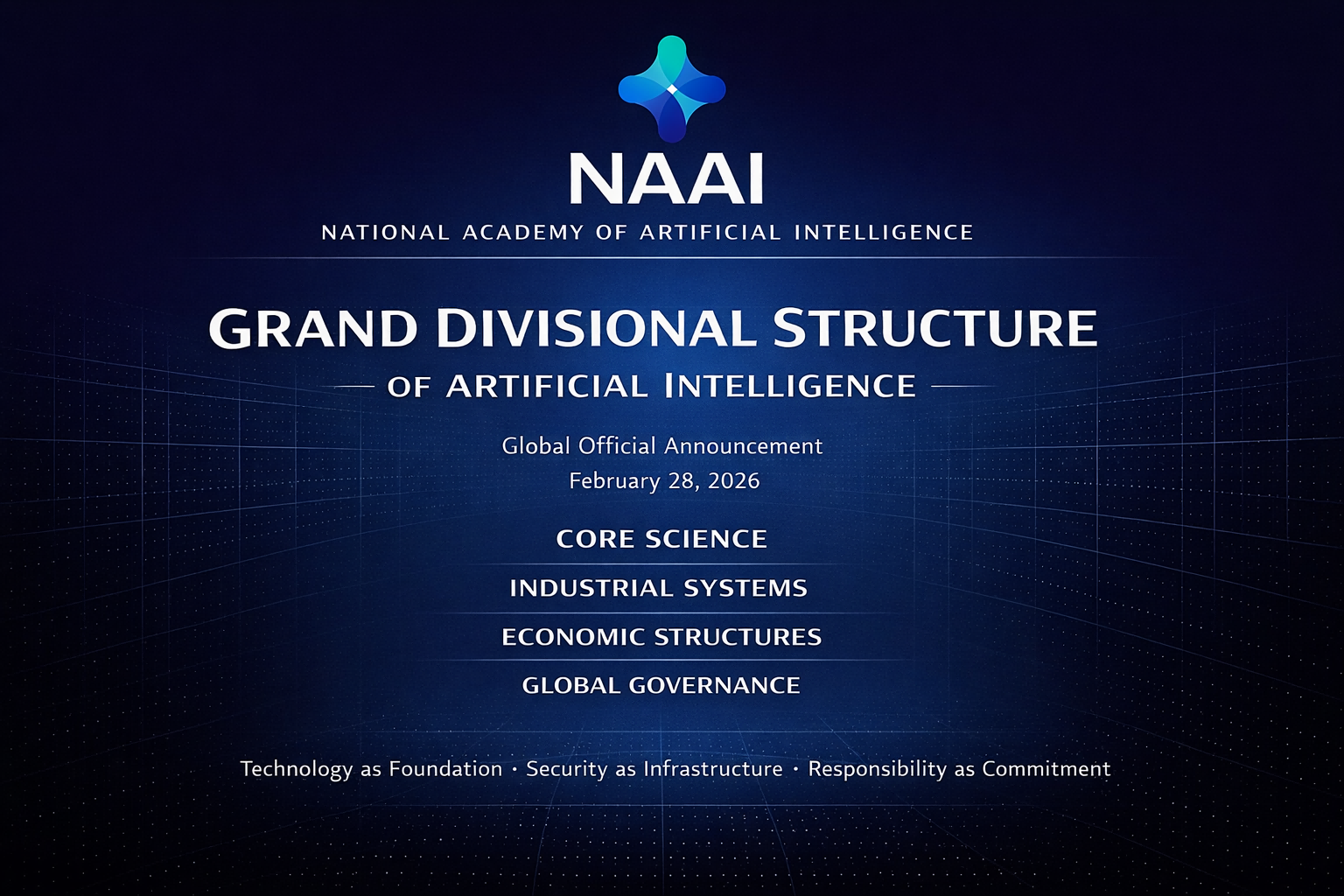
Announcement on the Establishment of the Grand Divisional Structure
Date: February 28, 2026
Artificial intelligence has emerged as a transformative General Purpose Technology reshaping scientific advancement, industrial systems, and global economic structures. Breakthroughs in AI theory, systems engineering, and cybersecurity capabilities have become foundational pillars of innovation and national competitiveness.
To further strengthen foundational research, enhance intelligent systems engineering capacity, reinforce security infrastructures, and advance interdisciplinary coordination, the National Academy of Artificial Intelligence (NAAI) hereby formally announces the establishment of its Grand Divisional Structure.
This framework is guided by the following principles:
Artificial intelligence foundational theory and systems engineering as the core
Cybersecurity and system protection as the technical security foundation
Industrial applications as strategic support
Economic structural research as an extension
Governance and long-term risk as safeguarding mechanisms
The Academy reaffirms that technological and scientific research constitutes its primary mission. Members from technical disciplines form the principal structure of the Academy.
I. Core Technical & Scientific Divisions (Primary Structure)
Division of Mathematical & Theoretical AI
Statistical learning theory, optimization, information theory, computational complexity, and foundational model research.
Division of Algorithmic & Intelligent Systems Engineering
Large-scale AI architectures, distributed systems, robotics, autonomous systems, and AI infrastructure.
Division of Cognitive & Brain-Inspired Intelligence
Computational neuroscience, cognitive modeling, and mechanisms of machine intelligence.
Division of AI Cybersecurity & System Protection
Adversarial robustness, model security, data protection, privacy-preserving technologies, cyber defense mechanisms, and intelligent system resilience.
II. Industrial & Engineering Expansion Divisions (Supporting Layer)
Division of AI & Engineering Systems
Intelligent manufacturing, smart infrastructure, aerospace systems, and complex engineered environments.
Division of AI & Healthcare Sciences
AI-driven innovation in medicine and life sciences.
Division of AI & Energy & Climate Systems
Energy optimization, smart grids, sustainability systems, and climate modeling.
Division of AI & Creative Industries
Technological innovation in film, music, digital arts, and content ecosystems.
III. Economic Structure Research Divisions (Extension Layer)
Division of AI Economics
Macroeconomic transformation, data assetization, and productivity systems.
Division of AI Finance & Digital Capital Markets
Algorithmic finance, digital currencies, and systemic risk modeling.
IV. Governance & Long-Term Stability Divisions (Safeguarding Layer)
Division of AI Governance & Global Policy
International coordination frameworks and regulatory architecture.
Division of AI Safety, Ethics & Long-Term Risk
Alignment research, interpretability, long-term civilizational risk, and system stability.
Structural Overview
The Grand Divisional Structure is organized into four integrated layers:
Core Layer — Technology, Algorithms, and Cybersecurity
Supporting Layer — Industrial & Engineering Systems
Extension Layer — Economic Structures
Safeguarding Layer — Governance & Long-Term Stability
This structure ensures technological leadership while maintaining systemic security and long-term global responsibility.
Strategic Vision
The National Academy of Artificial Intelligence remains committed to advancing technological innovation and security capacity as its central mission.
Artificial intelligence is first a science, then an engineering discipline, and ultimately a force shaping civilization.
The Academy will continue to promote responsible, stable, and sustainable development of artificial intelligence worldwide.